What does an AI receptionist cost per month, in real numbers?
Two numbers make up the bill, and both are published on this page: the monthly plan that carries your phone number, and the per-minute rate for the time the AI actually spends talking to callers. There is no separate AI subscription, no per-seat licence, and no minimum call volume.
| Your plan | Monthly | AI talk time | 100 calls × 3 min | Total for that month |
|---|---|---|---|---|
| Call Forwarding | $6.95/mo per number | 15¢/min | $45.00 | ~$52/mo |
| eBizLine Lite | $14.00/user/mo | 13¢/min | $39.00 | ~$53/mo |
| Business Phone Basic | $24.95/user/mo | 10¢/min | $30.00 | ~$55/mo |
The pattern is deliberate: the more your phone rings, the more the lower minute rate is worth. At 100 calls a month the three plans land within $3 of each other. At 500 calls a month (1,500 minutes) the same comparison is $232 on Call Forwarding, $209 on eBizLine Lite and $175 on Business Phone Basic — so the plan that costs more per month costs you $57 less in total.
How much does an AI receptionist cost compared to the alternatives?
Published rates, checked August 2026. Human answering services are usually sold per minute or in monthly minute bundles; AI platforms are usually sold as a monthly subscription with usage on top.
| Option | Typical price | What a light month costs you |
|---|---|---|
| eTollFree AI receptionist | From $6.95/mo + 15¢/min | $6.95 plus whatever minutes you used |
| AI add-on from a major phone platform | from ~$39/mo on top of your seat | ~$39, used or not |
| Human answering service (per minute) | ~$1.00–$1.50/min | $100–$150 for the same 100 minutes |
| Human answering service (bundle) | ~$200–$400/mo for a modest plan | The full bundle, used or not |
| Part-time human receptionist | ~$1,800–$2,600/mo | The full wage, plus cover for lunch and holidays |
| Voicemail | $0 | The callers who hang up instead of leaving a message |
The difference that matters is not the headline price, it is what a quiet month costs. On a subscription you pay the same in January as in June. Here, a slow month with 40 minutes of calls costs $6.95 plus $6.00 — about $13. That is the whole reason we price by the minute.
What would my business actually pay?
Solo trade — plumber, electrician, mobile mechanic
Roughly 60 calls a month, most of them under two minutes: "are you available Thursday", "how much for a callout". On Call Forwarding that is $6.95 plus about 120 minutes at 15¢ = $18. Real cost: about $25/mo to have every call answered while you are under a sink, on a ladder, or driving.
Dental or medical office
About 300 calls a month averaging three minutes — appointments, reschedules, insurance questions. On eBizLine Lite that is $14 plus 900 minutes at 13¢ = $117, so roughly $131/mo. A part-time front-desk hire covering the same phone hours is $1,800+, and the AI does not take lunch at the hour patients call most.
Law firm or high-value services
About 150 calls a month averaging four minutes, because intake questions take longer. On Business Phone Basic that is $24.95 plus 600 minutes at 10¢ = $60, about $85/mo. If a single retained matter is worth thousands, the arithmetic on one recovered call is not close.
Why per-minute instead of a monthly subscription?
Because a subscription charges you the same whether your phone rings or not, and small business call volume is seasonal. A landscaper's April is not their December. A tax practice's March is not their August.
Per-minute pricing means the cost tracks the work: $0 in AI minutes in a week where you answered everything yourself, and a bill that grows only when the AI is genuinely catching calls you would otherwise have missed. It also means you can try it on your real phone number without committing to a year of anything — every plan is month-to-month.
The trade-off is honest to state: if your business runs a very high call volume every single month, a flat monthly rate can beat per-minute. At that point talk to us and we will quote a flat rate for your volume rather than let the meter run.
What does the AI receptionist actually do on a call?
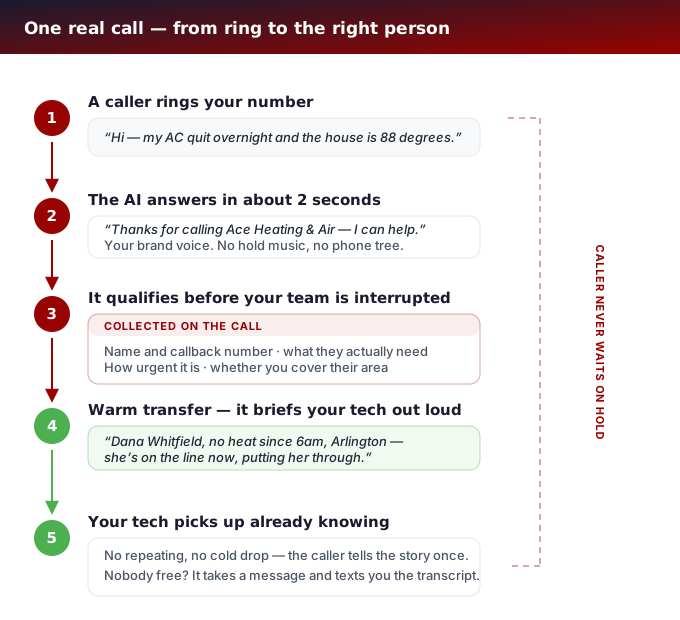
It answers on the first ring, in a natural voice, using scripts built around how your business actually works:
- Answers and greets the way you would — your business name, your hours, your services.
- Qualifies the caller — what they need, whether they are new or existing, how urgent it is.
- Books the appointment live against your real calendar, and confirms it before hanging up.
- Warm-transfers to a human when it should — staying on the line to brief your team, not a cold "please hold".
- Takes a message and texts you the transcript if nobody is available.
- Writes the CRM note after the call, so nothing depends on someone remembering.
It is not a phone tree. Callers are not pressing 1 for sales; they are talking, and the AI is listening and acting.
Does the AI receptionist block spam calls?
Yes — and it does more than silence them. It detects spam calls, blocks them from reaching you, and can reroute them to an alternate destination of your choosing. You decide where junk goes rather than having it dumped into your voicemail or left ringing your phone.
That matters more than it sounds for a small business. Spam and robocalls are a large share of inbound volume for a published business number, and every one of them trains you to stop trusting your own ringing phone. Screening them at the front means the calls that reach you are worth reaching you.
What happens when the AI doesn't know the answer?
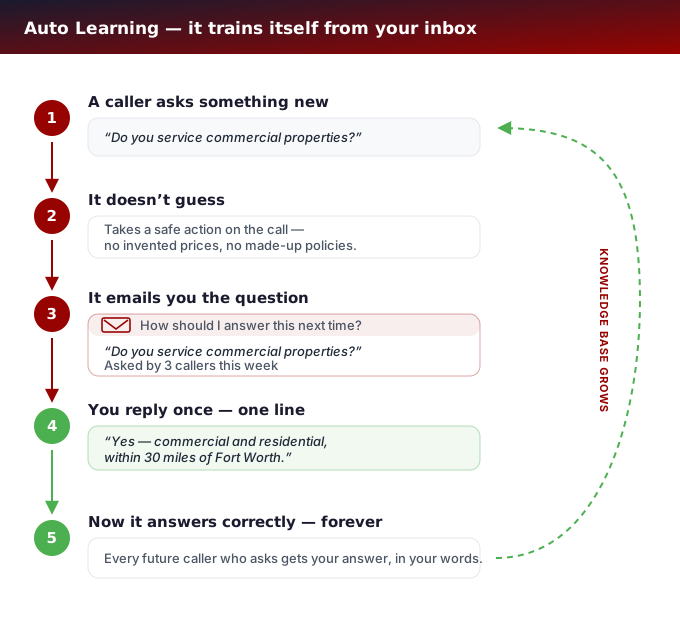
It doesn't guess — and this is the part that makes it get better on its own.
When a caller asks something the AI has no answer for, it takes a safe default action on the call rather than inventing something. Then it emails you the question: here is what the caller asked, and how should I answer this next time? You reply to that email in a line or two. Your answer is logged into its knowledge base, and from that point on the AI answers that question correctly — every time, for every caller.
So the knowledge base builds itself, interactively, out of real calls:
- A caller asks something new — "do you service commercial properties?"
- The AI handles the call gracefully instead of bluffing, and flags the gap.
- You get an email asking how to answer it.
- You reply once, in plain language.
- Every future caller who asks gets the right answer, in your words.
You are effectively training your receptionist from your inbox, a minute at a time, without logging into anything or writing a script. Most businesses find the gap emails taper off within the first few weeks, because real callers ask a surprisingly finite set of questions.
It is also the honest answer to the usual objection about AI on the phone. The risk people fear is confident nonsense — an AI inventing a price or a policy. This design refuses to guess: unknown means a safe response plus a question to you, not a fabricated answer to your customer.
Will I know what happened on each call?
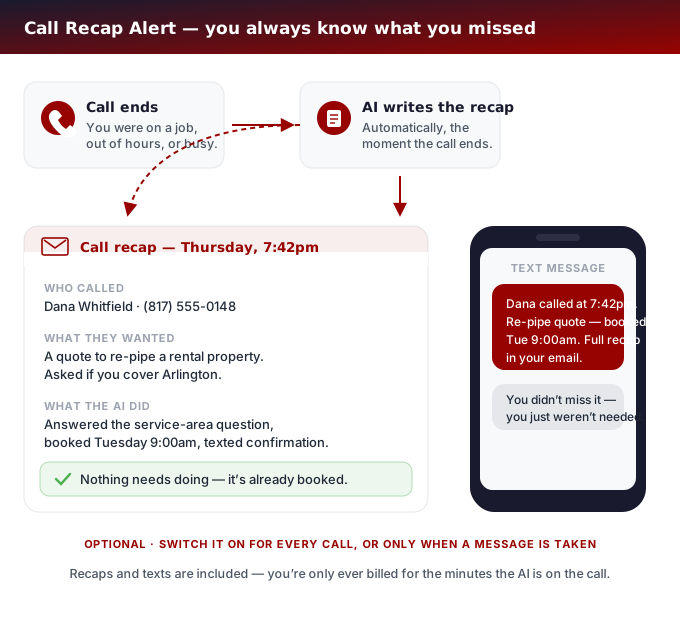
Yes. You can switch on an optional recap email after every call, so you'll never wonder what you missed while you were on a job or out of hours. It arrives with what the caller wanted and what the AI did about it.
Combined with the SMS transcript for messages, that means a call you never picked up still ends with you knowing exactly what happened — and with the caller's details already written into your CRM.
Can it transfer calls, book appointments, or text people?
All three. It transfers callers to a human when the call needs one, schedules appointments against your real calendar during the conversation, and sends SMS texts — confirmations, directions, a link, or a follow-up to the caller.
That is the difference between something that takes messages and something that finishes the job: the caller who reaches your AI at 8pm can be booked into Thursday morning and texted a confirmation before they hang up.
Is an AI receptionist worth it for a small business?
Do the arithmetic with your own numbers rather than ours. Take your average job value, and count the calls that went unanswered last month — evenings, weekends, while you were with a customer.
If your average job is $300 and you miss two calls a week, that is roughly $2,400 a month of work going to whoever picked up. Against that, $25 to $131 a month is not really a cost decision. If your average job is $45 and you miss one call a fortnight, be honest with yourself: voicemail may be fine, and we would rather tell you that than sell you something you do not need.
When is an AI receptionist the wrong answer?
Three cases, plainly:
- Your callers need a specific person, every time. If every call must reach one named expert, the AI is a routing layer, not a receptionist — useful, but you are buying less than you think.
- Your call flow changes daily. The AI follows the scripts and rules you set. If those genuinely change every morning, a human is more flexible.
- You get almost no calls. Under ~10 calls a month, a good voicemail greeting and a fast callback habit may be all you need. The $6.95 plan and its auto attendant would still be worth it; the AI minutes might not be.
What does it cost to get set up?
$0. No setup fee, no build fee, no onboarding charge. Our team builds your scripts, your voice (30+ voices to choose from), your transfer rules and your calendar connection, and you approve the agent before it takes a single live call. Most small businesses are live within 48 business hours.
Porting your existing number is also $0, and your current service keeps working until the transfer completes — so there is no window where a customer calls and hears nothing. If you would rather start on a fresh number, pick one from our available toll-free and local inventory.
How does this fit with my existing phone service?
The AI receptionist runs on an eTollFree number, so the phone plan and the AI are one bill and one place to change things. If you are already comparing phone plans, the full rate card and every fee is on our business phone service pricing page, and the toll-free-specific plans are on the toll-free pricing page.
You do not have to move your whole business at once. Plenty of owners start by pointing a single new number at the AI — the one on the truck, the website, or the Google listing — and keep everything else exactly as it is. If it earns its place, port the main number over later.
The short version
An AI receptionist here costs from $6.95/mo, which includes your phone number, plus 15¢ a minute of talk time — dropping to 13¢ on eBizLine Lite and 10¢ on Business Phone Basic. A typical small business lands between $25 and $131 a month. Setup is $0, porting is $0, there is no contract, and you can be live in 48 hours.
Every call answered, 24/7, for less than most businesses spend on coffee — enterprise-grade answering without the enterprise price tag.
Related reading
- Best AI receptionist and answering services (2026 comparison) — nine providers side by side on real prices, and which pricing model fits which business.
- How much does an answering service cost? — every published human-service tier, what pushes the bill up, and how to cut it.
- What is a virtual receptionist? — what one does, how answering services and AI receptionists differ, and whether to build or buy.
- Business phone service pricing — the phone plan underneath it all, with every fee listed.