
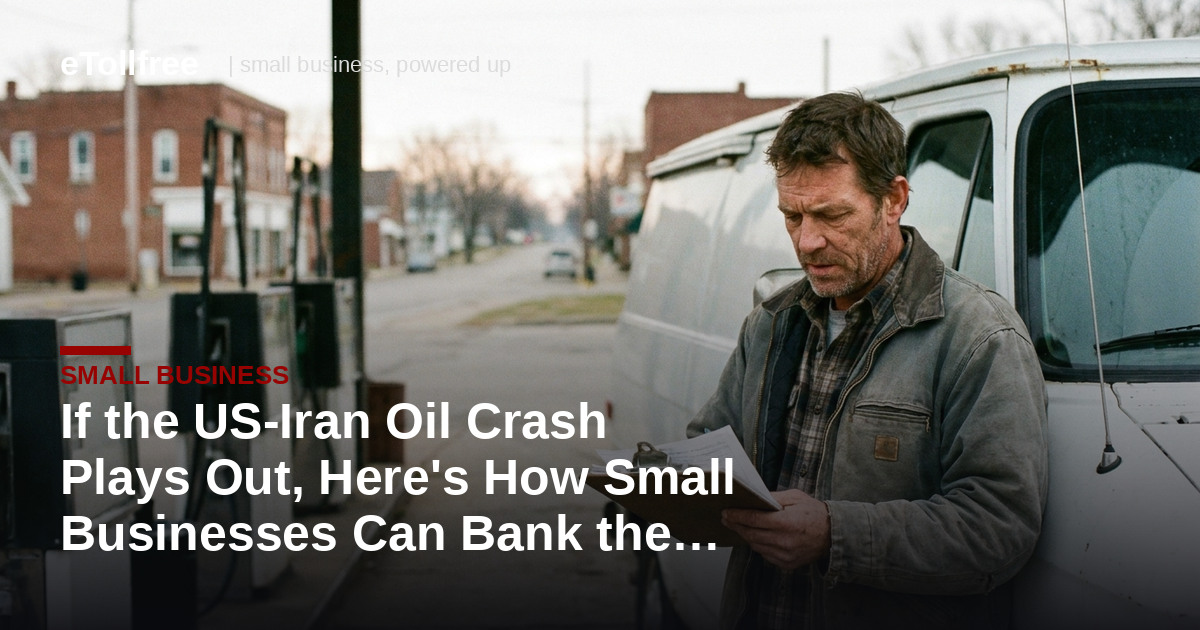
Scenario planning for fuel-exposed small businesses. The figures below reflect a possible US-Iran de-escalation scenario and the oil-price relief it could trigger — use them to build a playbook you can run the moment a real price drop arrives.
Picture this: the United States and Iran reach a deal to reopen the Strait of Hormuz, and oil prices fall to their lowest level in months. In a scenario like this, U.S. crude could drop more than 4.5% toward $80 per barrel after war-driven disruptions had pushed Brent above $114 per barrel, and a national gas price that had climbed roughly 54% from pre-war levels (peaking around $4.55) could see gasoline futures slide back below $3 per gallon.
If you run a delivery, food service, trades, retail, or logistics-dependent business, a premium like that unwinding fast is real money you can keep. But here's the catch: a window like this would be narrow.
Why a Window Like This Wouldn't Stay Open
In the ceasefire-optimism scenarios analysts have modeled, global oil prices could tumble around 20% from highs. But analysts are clear that normalization would take time. Even if the Strait of Hormuz reopens, that opening would likely only be partial — there could be significant damage to infrastructure, refineries, and pipelines across the Gulf, plus mine clearance, tanker security concerns, and uncertainty over shipping control. Translation for owners: any relief would be real but temporary, and it would get competed away. The businesses that act fast capture the savings. The ones that wait watch them evaporate.
Where the Savings Actually Live
Fuel isn't a marginal cost for the most exposed small businesses — it's a core operating expense. According to the Bank of America Institute, small businesses in transportation, agriculture, and construction devote a noticeably larger share of their card spending to gasoline than other sectors. Higher fuel prices also feed into broader cost structures, raising transportation, input, and inventory costs across the board. So when oil drops, you'd have four concrete levers to pull:
1. Lock in fuel pricing. That's the moment to negotiate fixed-rate fuel contracts or better terms on commercial fleet fuel cards — before prices drift back up over a 3–6 month normalization period.
2. Renegotiate shipping and last-mile contracts. Carriers getting their own cost relief gives you leverage. In a volatile market, the contract details matter as much as the rate: fuel surcharge formulas, minimum charges, accessorial terms, escalation clauses, and rate validity periods all shape your true cost.
3. Attack fuel surcharges on your invoices. This is the big one. Fuel surcharges can run 15–25% of total freight costs, and for many shippers, surcharges overall account for 30–40% of total parcel spend — with fuel typically the single largest surcharge category at 25–30% of surcharge spend. Both FedEx and UPS publish weekly fuel surcharge tables that float with diesel prices. As oil drops, those indexed surcharges fall — but only if you're watching your invoices. You can't negotiate the published index, but you can negotiate a cap: 'fuel surcharge shall not exceed 10% of base rate regardless of index.'
4. Reassess inventory timing. For goods with high shipping-cost components, a dip is a chance to time replenishment smartly.
Stay Reachable When the Calls Start — Without Blowing the Savings
Negotiating fuel contracts, renegotiating carriers, and chasing surcharge corrections all come down to one thing: conversations. Suppliers, carriers, and reps need to reach you, and your customers need a professional line they trust when you're scaling up to capture a low-cost window.
That's where eTollfree comes in. eTollfree gives small businesses affordable toll-free and local business phone numbers with the kind of call management tools — call routing, voicemail, and forwarding — that let a lean operation sound like a major carrier and never miss the call that locks in a better rate. When you're working the phones to renegotiate freight and fuel terms, a reliable, professional toll-free presence is the low-cost infrastructure that helps you actually bank the savings instead of letting opportunities go to voicemail.
Don't Spend the Savings — Bank Them
Here's the move smart owners make: the dollars you free up from lower fuel and freight costs shouldn't dissolve back into day-to-day spending. Park them where they keep working. A high-yield business savings account lets your reclaimed margin earn while you wait out price normalization. It's worth comparing business savings rates across providers — the point isn't which one, it's that you treat any oil-crash relief as a chance to build a cushion, not just break even.
The Mission
Every dollar you reclaim from a surcharge you no longer owe is a dollar you can put back into payroll, equipment, or growth. That's how we build the economy back up — one small business holding onto more of what it earns. The key is being ready before the window opens, with the contracts, the playbook, and the communication tools to move fast.
Don't let the next money-saving call go to voicemail. Get a professional toll-free or local business number from eTollfree — and make sure you're reachable when it counts.
🔒 Lock In Your Business Phone Line Now — Plans from $6.95/mo
Questions? Call our team: 866-273-4639 | No long-term contracts. No hidden fees. Set up in minutes.
Join the Conversation